How to Build a Real Home Gym in Under 100 Square Feet
You don't need a garage or a building amenity to train seriously. Here's how to build a genuinely good gym in a corner, a closet, or 90 square feet — starting with the one question that decides everything.
Property is getting more expensive, and space with it. More people are training in apartments and condos than ever — and the ones with a decent building gym are the lucky minority. If your building doesn't have a fitness room, or the one it has is two treadmills and a broken cable machine, the good news is simpler than it looks: you can build a genuinely good gym in under 100 square feet. A corner of a bedroom, a cleared-out closet, the end of a basement. I've trained out of spaces that size for years. It works — if you plan it instead of just buying things.
The mistake almost everyone makes in a small space is the same one people make in a big one: they buy too much. A rack they end up draping laundry on, a treadmill that becomes a shelf, a bench buried under boxes. In 100 square feet you don't have room to be wrong. That constraint is actually a gift — it forces you to buy only what earns its footprint.
Start with the objective, not the equipment
Before you look at a single piece of equipment, answer one question: what are you actually training for? Not 'get in shape' — specifically. Strength? Muscle? General conditioning and mobility? Hybrid training that mixes lifting and cardio? Your answer decides everything downstream, because equipment that's perfect for one goal is dead weight for another.
In a small space this matters more, not less. You only get to make a handful of choices, so each one has to point at your actual goal. Someone chasing a bigger squat needs a different setup than someone who wants to look good, move well, and break a sweat four times a week. Most people reading this are the second person — so that's who the rest of this is written for.
The core: adjustable dumbbells and a bench
If you're into hybrid or functional training — and in a small space, you probably should be — the single best foundation is a pair of adjustable dumbbells and an adjustable bench. That's it. That's the anchor.
Adjustable dumbbells are the most footprint-friendly serious training tool that exists. One pair replaces an entire rack of fixed dumbbells — anywhere from 5 to 50-plus pounds per hand — in the space of a couple of shoeboxes. They tuck into a corner, slide under a bench, or sit on a small stand. Pair them with an adjustable bench and you can train every major muscle group: presses, rows, squats, lunges, hip thrusts, curls, extensions. For most people at any level, that combination alone is a complete gym.
The numbers make the case. A set of adjustable dumbbells occupies roughly 2 square feet of floor. A folding or upright bench, another 4 to 6. You're anchoring your whole gym in under 10 square feet — and every piece of it is something you'll actually reach for.
Add kettlebells for range
Once the dumbbell-and-bench core is in, the highest-value addition is a kettlebell or two. Low footprint, high versatility — that's the whole name of the game in a small space, and nothing embodies it better than a kettlebell. Swings, cleans, presses, goblet squats, carries, Turkish get-ups: one cast-iron bell covers strength, power, and conditioning in a piece of equipment the size of a small pumpkin.
One thing to check before you commit to ballistic work: ceiling height. A swing or a snatch sends the bell overhead, and in an apartment with an 8-foot ceiling you can clip it fast. Measure the height at the exact spot you'll train, arms fully overhead, before you assume swings are on the table. If the ceiling's low, lean on goblet squats, presses, and carries instead — still enormous value from a single bell.
Flooring: protect the floor, don't cover the room
If you're renting, flooring isn't optional — it's what gets your deposit back. The good news is a small space keeps it cheap. You don't need to cover the whole room. You need protection exactly where load meets floor: under the bench, wherever you'll set down or drop weights, and wherever a kettlebell might come down.
For those zones, use proper rubber stall mats — at least 3/4 inch (19 mm) thick. Thinner puzzle-foam tiles feel nice underfoot but won't save a hardwood floor, or the downstairs neighbor's ceiling, from a dropped bell. One or two 4×6 stall mats at about $50 each is usually all a sub-100-square-foot gym needs. For the rest of the space — stretching, bodyweight work, mobility — a simple yoga mat does everything you need. There's no reason to rubber-floor a corner you're only going to do push-ups in.
Bodybuilding on a budget, and the all-in-one bench
If your space is really tight and your goal is building muscle without spending much, you can go further with less. An exercise ball and a set of resistance bands cover a surprising amount of ground — core, stability, presses, pulls, and rehab-style work — for the price of a couple of restaurant meals, and they store in a drawer.
But if you can fit one 'real' piece and bodybuilding is the goal, this is where an all-in-one bench earns its keep. These are adjustable benches with attachments built in — a leg developer for extensions and curls, a preacher pad for biceps, sometimes pec-fly arms — so a single frame covers muscles a plain bench can't touch. For a beginner-to-intermediate lifter on a budget, in a footprint not much bigger than a normal bench, it's the most training per square foot, and per dollar, that you can buy. Three worth looking at:
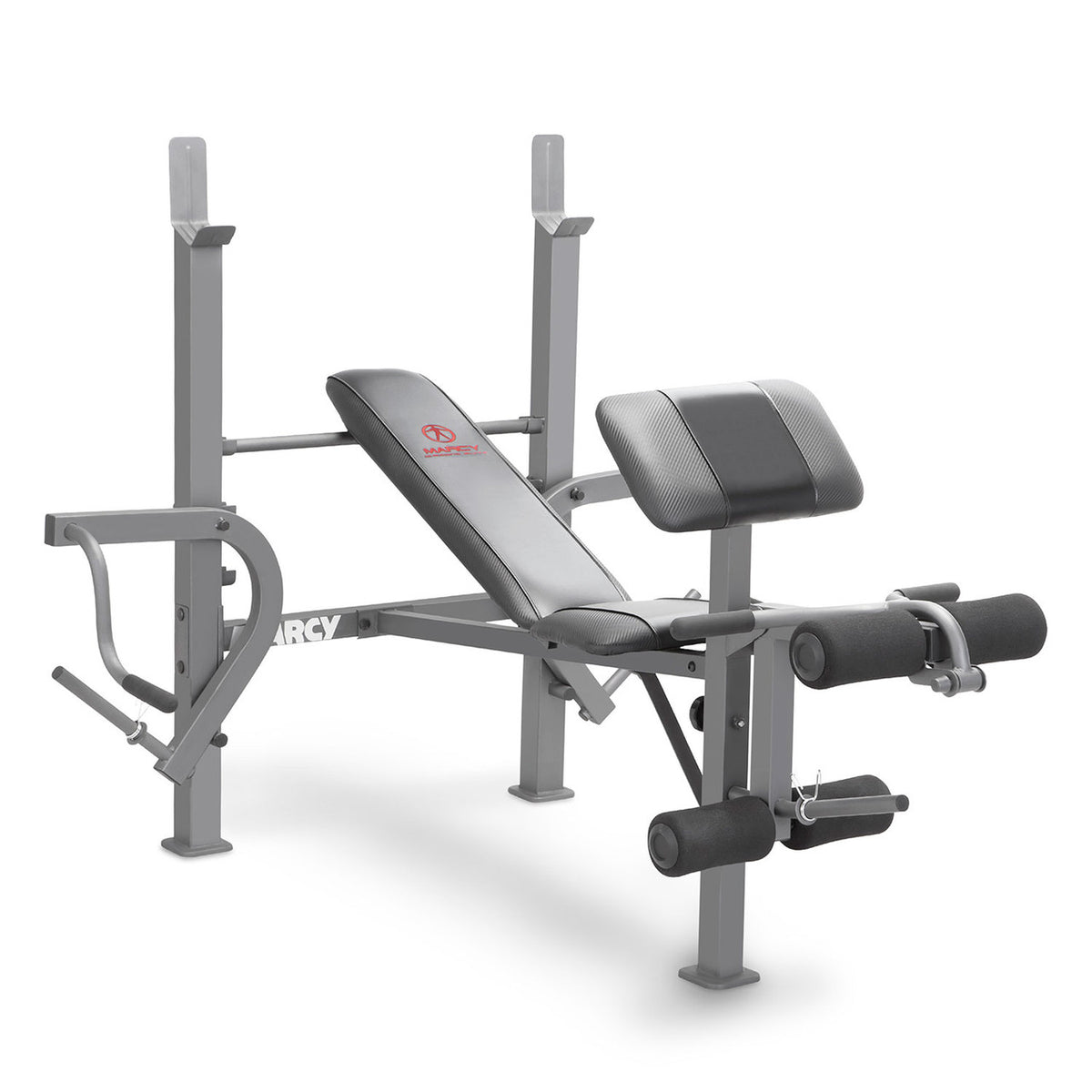
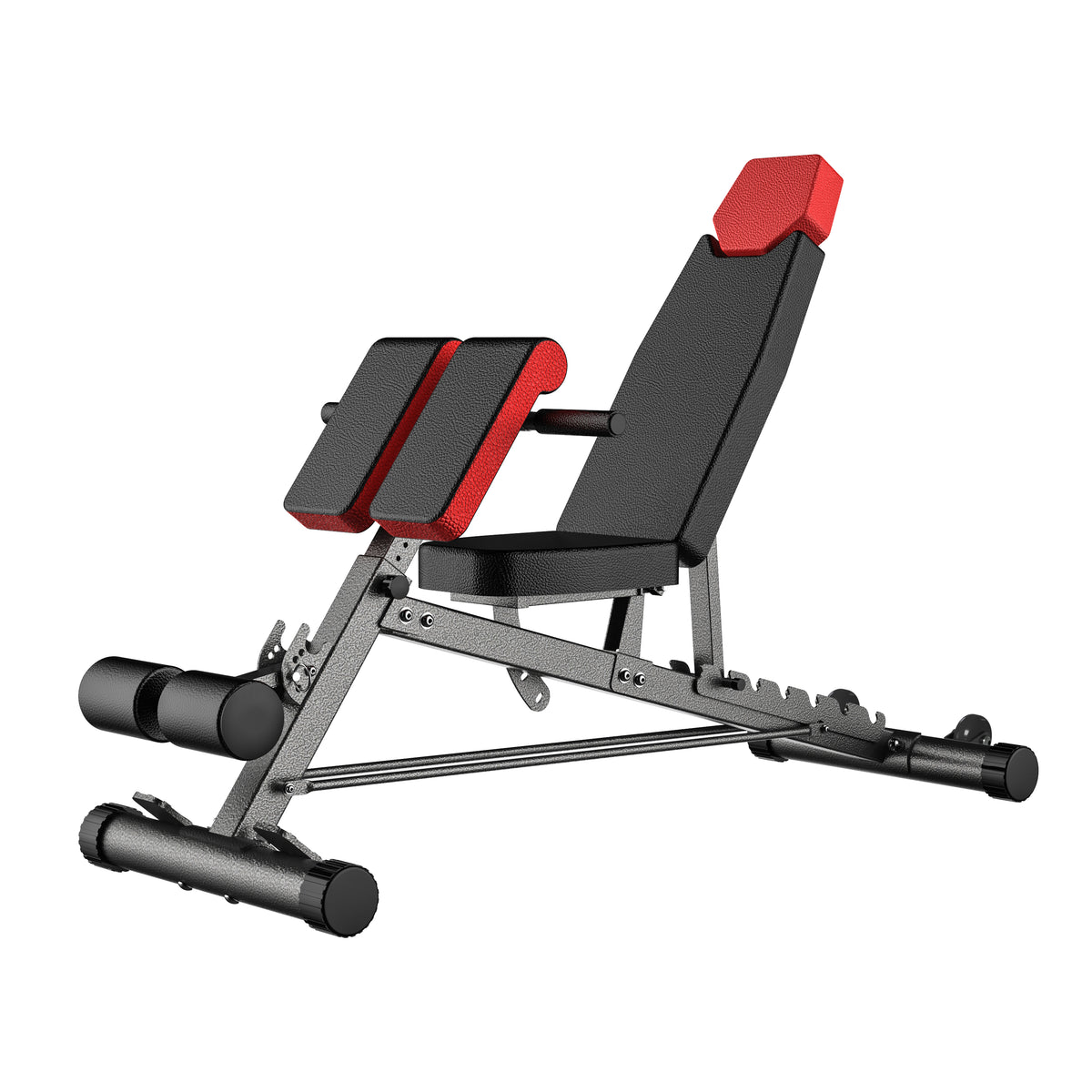
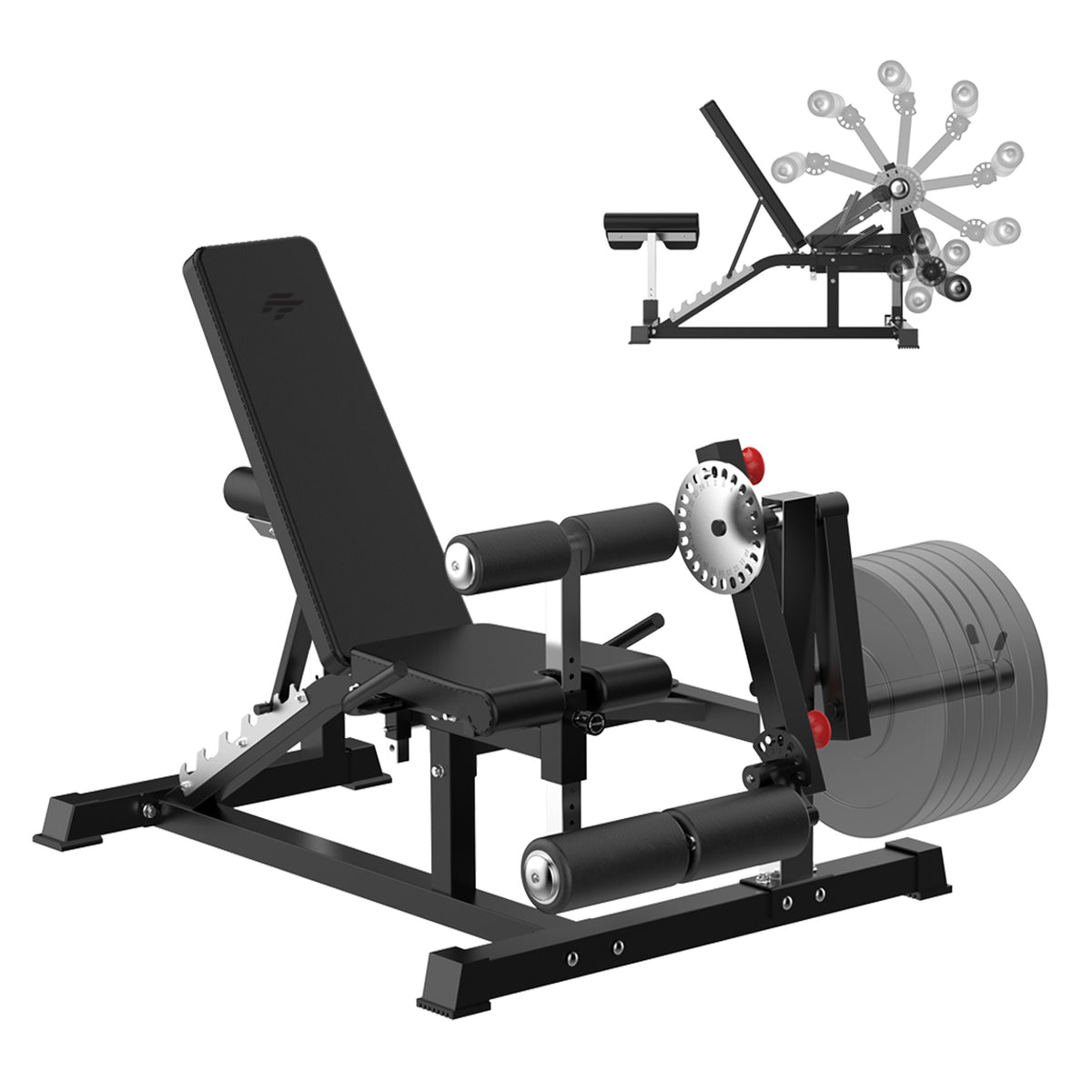
One honest note: the attachments on these are basic compared to dedicated machines, and the lighter frames can wobble under a heavy load. That's the trade for the price and the footprint — and for most people building at home, it's a trade well worth making. Just don't expect a $200 all-in-one to feel like a commercial leg-extension machine. It isn't one, and it doesn't need to be.
If your budget — and your space — can stretch
The premium end of this category has gotten genuinely good, and it's built on the exact same small-space logic: one footprint that does the work of a room full of machines. If you've decided the bench is going to be your anchor and you'd rather buy once, two are worth knowing about.
The one everyone's talking about is the Tib Bar Guy Apex. Garage Gym Reviews' Coop rates it as about the most versatile bench you can buy — the bench itself is a heavy, commercial-feeling FID at roughly $600, but it's the base of an ecosystem of eleven attachments and accessories that turns it into a belt-squat station, a Nordic setup, a dip station, a landmine, and more. Kit it out completely and you're near $2,500 for something that genuinely replaces a wall of machines. The other is the Freak Athlete ABX — two years in development, ten functions in one frame, and around $500–600. It leans more 'do-everything bench' than 'ecosystem,' which for a tight room is arguably the point.
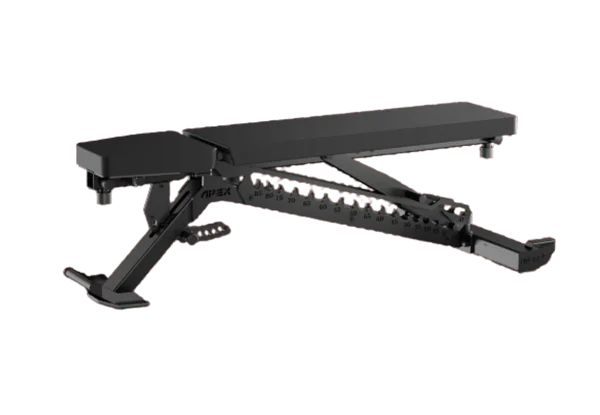
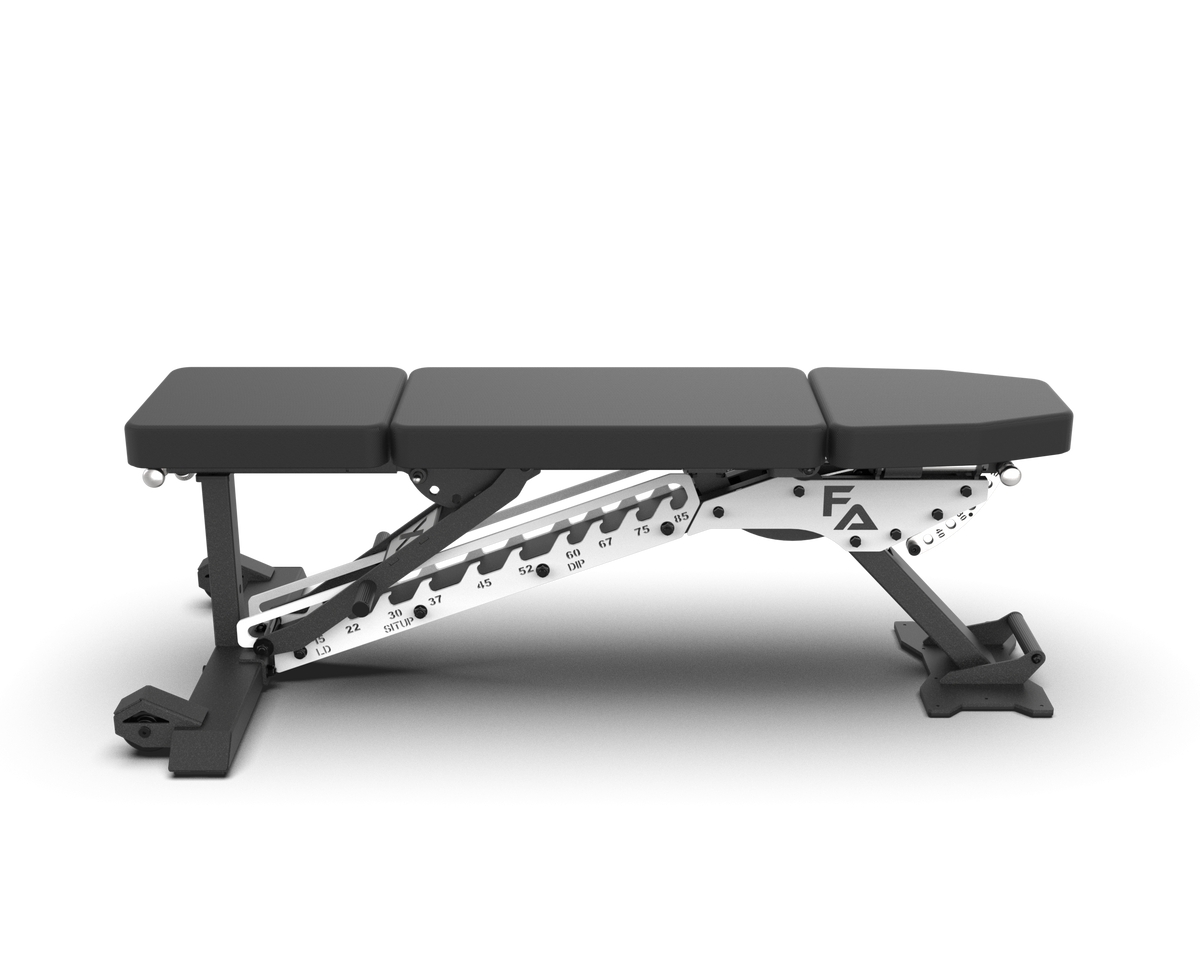
Here's the catch, and it's the whole thesis of this piece turned on its head as a warning: at the fully-kitted end, you're spending power-rack money on a bench. That only makes sense if you've genuinely committed to the bench-centric approach — and even then, you almost certainly don't need every attachment on day one. Buy the frame, add the two or three attachments that serve your actual goal, and let the rest wait. The point of one footprint was never to cram twenty-five machines into it. It was to own less, and use all of it.
Make the corner somewhere you want to be
Here's the part almost every small-space guide skips, and it's the one that actually decides whether you train: if your gym is a grim little corner crammed between a desk and a laundry pile, you won't want to walk over to it. Restricted space has a way of killing the desire before you've even warmed up.
So treat the setup like a room you want to be in, not just equipment that happens to fit. Give it a little breathing room around the mat. Put it near a window if you can, for the light. Add a plant or two — greenery genuinely makes a tight space feel less boxed-in and more like somewhere you'd choose to spend twenty minutes. A mirror on one wall opens the space up and helps you check your form. None of this costs much, and it's the difference between a corner you avoid and a corner you look forward to.
Plan it before you buy it
All of this fits in a space most people would write off as too small. The trick isn't more room or more money — it's deciding what you're training for, then buying only the few pieces that serve it and arranging them so the space actually feels good to use. Before you order anything, map it to scale: drop your bench, your dumbbell stand, and your mat zones into a plan of your real room and check the clearances — especially that overhead room for swings and presses. Thirty minutes planning a 90-square-foot gym saves you from the one mistake small spaces don't forgive: buying something that doesn't fit.
A small gym isn't a compromise. Built around the right few pieces, a well-planned corner will out-train a garage full of equipment nobody uses. Start with the goal, buy less than you think, and make it a place you want to go.